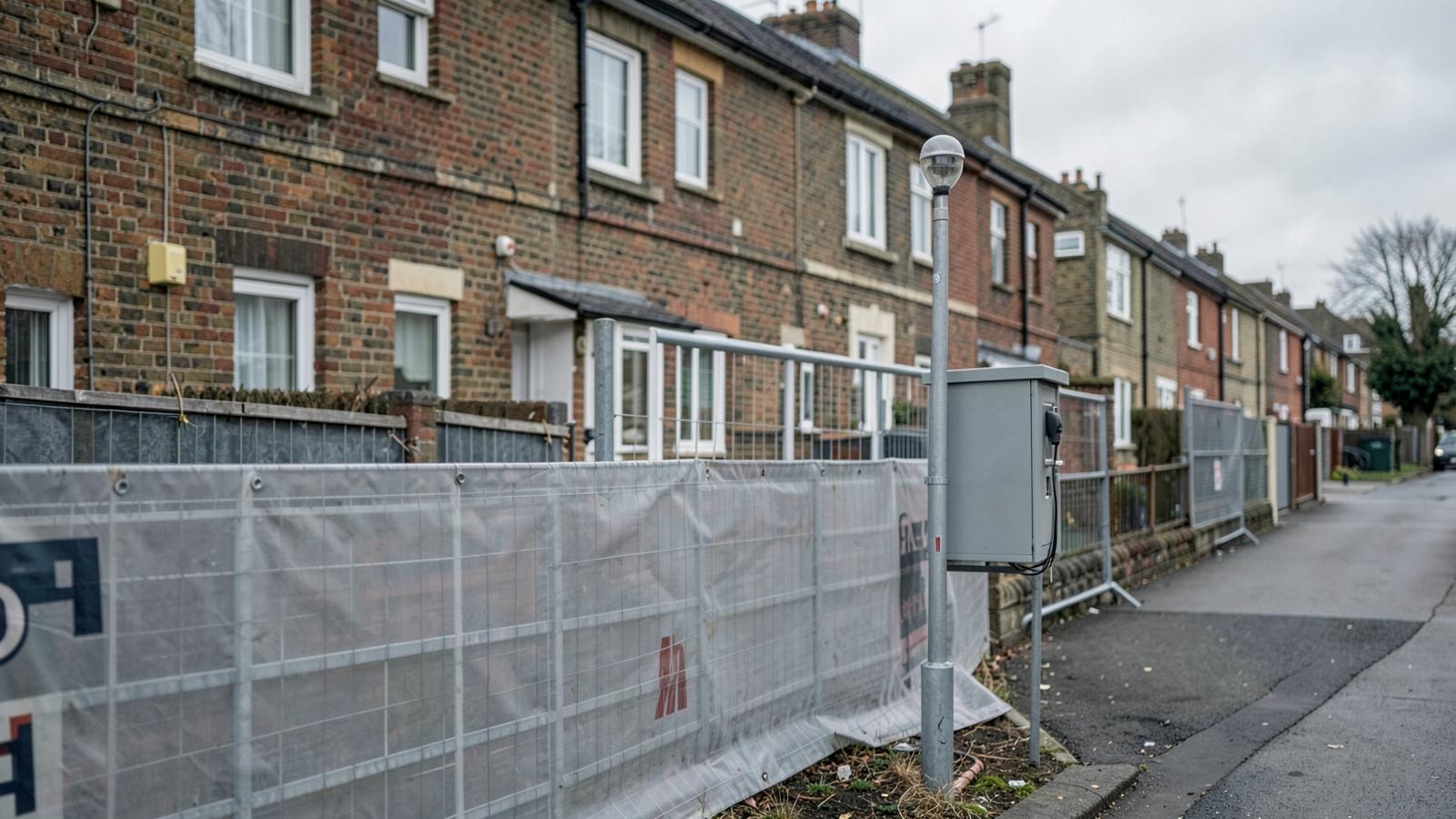
Monitoring — noise
Noise monitoring, deployed and kept running for the length of your project.
NVD can provide noise monitoring as a complete managed service: the instrumentation, the installation, the power and communications, the alerts and the reporting — for construction and demolition projects, sensitive boundaries and live events.
In plain English
What is noise monitoring?
Noise monitoring means measuring and recording sound levels over time at agreed positions, so a project has an ongoing record of what the noise environment was actually doing rather than a single spot reading. Environmental noise monitoring is commonly used during construction, demolition and infrastructure works, at events, and on any project where noise needs visibility while the activity is taking place.
Construction noise monitoring may form part of a project approach developed with reference to BS 5228 where applicable. NVD handles the practical deployment and operation of the monitoring system to the requirements supplied for the project.
In the field
What a noise monitoring position has to cope with
Where specialist judgement is required, the technical monitoring position or receptor selection can be supplied by the client or its appointed specialist. These are the practical field considerations NVD deals with once the position is agreed.
- The monitoring position supplied or agreed for the project
- Secure mounting to a pole, hoarding, fence, scaffold or building
- Microphone height and exposure, clear of obstructions and reflecting surfaces
- Safe access for installation and for later attendance
- Mains, battery or solar power, sized for the expected duration
- Communications for data transfer, and antenna position where signal is marginal
- Weather and exposure at the position over the monitoring period
- Risk of disturbance or damage from site traffic, plant and ongoing works
- Whether the position is likely to need relocating as the works progress
Where it is used
Typical noise monitoring situations
Construction & demolition
Noise recorded at the boundary while the works are under way, so the project has an objective record rather than an argument about perception.
Neighbour & community concern
Where a concern or complaint has been raised, monitoring gives the site team something factual to work from and to respond with.
Residential & sensitive locations
Positions close to homes, schools, healthcare or other sensitive receptors near active works.
Long-term site monitoring
Continuous monitoring across the life of a project, with positions moved as the work progresses.
Live events & festivals
Where agreed sound levels need live visibility during the event, so decisions can be made while it matters.
Defined project requirements
Where thresholds and measurement requirements are already defined by the client, the specification or an appointed acoustic specialist.
Instrumentation
Genuine Class 1 instrumentation
For noise monitoring delivered as an NVD managed service, instrumentation is genuine Class 1 and conforms to the latest applicable IEC 61672-1 / BS EN 61672-1 requirements.
NVD is manufacturer-neutral and selects or arranges equipment around the project requirement. Where instrumentation is already specified or supplied, NVD can work with it where it meets the agreed project requirements and, for the managed noise-monitoring service, the required Class 1 standard.
The service around the instrument
An instrument on a pole is not a monitoring service
Most of the value is in everything that keeps the measurement continuous and the information usable.
Deployment at agreed positions
Instruments installed at the monitoring positions agreed for the project, mounted appropriately for the location, exposure and duration.
Power & connectivity
Mains, battery or solar power and the communications needed to keep the position reporting reliably.
System health
Ongoing checks that each position is powered, connected and logging, with problems picked up by NVD rather than by the site team.
Live & remote data
Where the deployed system supports it, remote or live access to the measurement data for the people who need it.
Threshold alerts
Notifications against the thresholds agreed for the project, sent to the people you nominate.
Scheduled reports
Structured monitoring summaries at the agreed interval — weekly, fortnightly, monthly, event-based or project-stage based.
Maintenance & fault response
Attendance for faults, power problems, connectivity issues and equipment swaps, with replacement equipment where required.
Relocation & recovery
Positions relocated as the works move, then decommissioned and recovered at the end of the project.
Before deployment
What to have in mind before the first position goes in
If any deployment information is still outstanding, NVD can help identify what is needed and work alongside the client's appointed specialist where technical criteria or methodology must be supplied.
- Where the monitoring positions need to be, and how many
- The measurement parameters and logging arrangements required
- Any thresholds, warning levels or action levels that apply
- Who receives alerts, and how quickly they need them
- Reporting frequency and recipients
- Expected duration of the monitoring
Working alongside specialists
Thresholds and methodology
NVD manages the practical monitoring deployment and field operation. Measurement requirements, thresholds and methodology can be supplied by the client or its appointed acoustic or environmental specialist, and NVD deploys and operates the system to those requirements. Where specialist assessment, acoustic modelling or interpretation of the data is needed, that sits with the appointed specialist.
Related
Managed Monitoring Overview
How the managed service works, the monitoring plan, alerts, reporting and system continuity.
Vibration Monitoring
Often deployed alongside noise on demolition, piling and excavation projects.
Dust & Air Quality Monitoring
Particulate and air quality monitoring where earthworks or urban conditions require it.
Maintenance & Fault Response
The field capability that keeps deployed monitoring systems operational.
Contact NVD
Send the site location, positions and duration and NVD will come back to you.
Send the noise monitoring requirement
Location, likely monitoring positions, expected duration and who needs to see alerts and reports — that is enough for NVD to come back to you.